
President Asif Ali Zardari will leave on a day-long visit to Iran on Monday to formally inaugurate work on the Pakistan-Iran gas pipeline despite the US threat of possible sanctions over Tehran's nuclear programme.

Iranian President Dr Mahmoud Ahmadinejad called the Organisation of Islamic Conference an ineffective body, welcomed the ceasefire in Gaza and proposed free and fair elections to end the crisis in Syria.
Highly tilted trade relations in favour of Iran, supply of oil and gas and other key strategic bilateral and international issues, including Syria, are expected to dominate the meetings of Prime Minister Manmohan Singh with Iran's supreme leader Ayatollah Ali Khamenei and President Mahmoud Ahmadinejad in Tehran.
Mahmoud Ahmadinejad has been criticised by Iranian religious and political groups after a picture from funeral for Hugo Chavez showed him getting up close and personal with the mother of the late Venezuelan president.
Iran has offered to provide Pakistan $500 million to build its section of a bilateral gas pipeline project on the condition that Islamabad will not turn its back on the venture, a media report said.
Iran's Vice President Ali Saeedlou has cancelled his visit to Pakistan at the eleventh hour in an apparent indication of unease in bilateral ties, marking the second major diplomatic setback for Islamabad since Russian President Vladimir Putin called off a trip last month.
A host of meeting with the leaders of other NAM countries, including Pakistan, is also likely to take place on the sidelines of the 16th Summit of 120-nation grouping, Foreign Secretary Ranjan Mathai said while briefing reporters in New Delhi on Prime Minister's four-day Iran visit.

Azadi Square in central Iran witnessed the country's biggest protest in over three decades when thousands turned up to condemsn the alleged rigging of the recent presidential elections.

While one is not anticipating a sea change in Iranian politics, in Hassan Rowhani, Iran may have found a President who will, at the very least, be less verbally aggressive than the outgoing Mahmoud Ahmadinejad. There is a strong possibility that he will work towards changing Iran's relations with the world, says Arfa Khanum Sherwani.
As tensions mounted in the Persian Gulf, Pakistan on Thursday assured Iran that it will not provide any assistance to American forces in the event of a United States attack on Tehran.
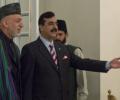
Afghanistan President Hamid Karzai arrived in Islamabad on Thursday on a two-day state visit for bilateral talks and to attend a tri-lateral summit of Afghanistan, Iran and Pakistan that will focus on the regional security situation, officials said.
Russia has consistently supported Iran's right to civilian nuclear energy under the Nuclear Non-Proliferation Treaty, and is building a nuclear power plant for the Islamic nation in Bushehr.
State Department's Deputy Spokesman Tom Casey made this observation on Monday when asked whether the US has any concerns about Ahmadinejad proposed visit to New Delhi and whether there had been any message sent to India about the proposed meetings. Casey said it's up to every country to determine for itself how it's going to organise its bilateral relations.
'When a government doesn't take shape within the framework of the law, it has no legitimacy in the eyes of the people. This weakens the government and encourages the government to resort to violence against the people,' The Star Online quoted Mousavi, as saying.
A Washington Post report, quoting both US officials and South Asian experts, says that the arms race between India and Pakistan 'has begun to take on the pace and diversity, although not the size, of US-Soviet nuclear competition during the Cold War.'

Leaders of the Shanghai Cooperation Organisation gathered for their 5th summit in Shanghai
Observing that the future of Afghanistan has a regional dimension, the Obama Administration has hoped that Iran would play a constructive role in bringing long-term peace and stability in the war-torn country.
Analysts suggest that with the Indo-US nuclear deal in limbo, New Delhi could be balancing foreign policy with an eye to the polls. They say that India's sharp response to the US State Department's 'advice' on Iran was one such move. While some felt the response was a case of dangerous over-reaction, others said it was merely an act of diplomacy where relations with other countries, particularly the US, are balanced to suit India's interests.
A CPI-M member in the Lok Sabha,on Wednesday asked the government to condemn a United States State Department statement that India tell Iran to 'meet the requirements of the UN Security Council' on its nuclear programme during Iranian President Mahmoud Ahmadinejads upcoming visit.
Congress chief Sonia Gandhi and Uttar Pradesh Chief Minister Mayawati are among the four Indians named in the Financial Times list of '50 People Who Shaped the Decade.'
A suicide attack at a meeting between Iran's elite Revolutionary Guards and tribal chiefs killed at least 49 people in the city of Pisheen, near the Pakistan border, on Sunday.Several tribal leaders and seven members of the elite Revolutionary Guards died when the attacker, who was wearing an explosive belt, set it off at the meeting.President Mahmoud Ahmadinejad claimed that the attack had been plotted in Pakistan.

Former US secretary of state Condoleezza Rice has said she does not regret the 2003 Iraq war to oust America's "implacable enemy" Saddam Hussein, but admitted that it was a "mistake" to put the spotlight simply on the weapons of mass destruction, which were never found.
Embattled Pakistani President Pervez Musharraf and his United States counterpart George W Bush are among the world's least trusted leaders along with Iran's Mahmoud Ahmadinejad, a new survey in 20 countries, including India, shows.Musharraf has the poorest ratings around the world. Only in China, 37 per cent of the people feel that he inspires confidence as a leader, outweighing negative views (30 per cent), the poll conducted by WorldPublicOpinion.org Just two countrie
In remarks bound to rankle the Left parties in India, the Bush administration hoped that New Delhi would also ask Iran to comply with the United Nations Security Council's other requirements regarding its nuclear programme. Washington would also encourage New Delhi to ask Iran to "become a more responsible actor on the world stage by ending its rather unhelpful activities" regarding Iraq and support for terrorism, State Department Deputy Spokesman Tom Casey said.
Iranian president said that Tehran has repeatedly made it clear that its nuclear programme is only for peaceful purposes.
At a time when the nuclear deal was being negotiated, the United States had tried to pressurise India over its ties with Iran and even objected to President Mahmoud Ahmadinejad's visit to Delhi, saying it would give 'platform for an enemy of the US', according to Wikileaks documents. The cables sent by the then US ambassador David Mulford to the State Department make it clear that India did not want America to tell it "what to do, especially in public".
Ahmadinejad said he is willing to talk with the Europeans and the Americans. "We have announced as much, that we are going to negotiate. But again, based on justice and mutual respect. Well, after everything is said and done--well, planning needs to be made, and some timetables need to be set. We believe in talking, in negotiating, based on sincerity and respect and justice," he said in his interview through a translator.
Iran may put the $22 billion deal to sell liquefied natural gas to India on the backburner as New Delhi refuses to re-open the contract sealed two years ago, according to an assessment by the petroleum ministry.
He denied suggestions that he sought conflict with the US, saying Iran was 'trying to find ways to love people.'

The launch of the satellite named 'Omid' was announced by President Mahmoud Ahmadinejad, who said it had been put in the orbit. It was launched with the help of Safir-2 rockets.
The spokesman was non-committal in the kind of response of the United States.
Iranian President Mahmoud Ahmadinejad may have used a mix of charm and roguish coercion to let India know that he expected the Iran-Pakistan-India gas pipeline proposal to become a reality in 45 days. But India is in no hurry to take a decision, a top Cabinet minister in the United Progressive Alliance government said. The volatile political environment in Iran and Pakistan has as much weightage now and the UPA government is becoming more reluctant.
Central Asia with Iran as a major gas supplier is the arena where the new 'great-game' is being played out and China, India and Japan are all seeking to protect their respective energy interests for the medium term -- and pipeline politics is the new instrumentality
"We need to make sure that the Iran pipleline project is economically viable. This project has a life of 40 years," Menon tol the media in Delhi. Menon confirmed that India was trying to re-negotiate the Liquefied Natural Gas project with Iran. The deal was first made in 2005, but India feels there could be renegotiation.
Iran blamed America for the cancellation saying they had delayed the issuance of visas to the crew of the special plane that would have carried Ahmedinejad to New York for the meeting.
"We think that the US is following another policy trying to hide its defeats and failures and that is why it is pointing its fingers to others," he said.

The Guardian profiles the man who leads Iraq at its most troubled time.
"India has immense credibility in the whole world because it is the largest and is a true democracy and I believe India can play a very important diplomatic role in bringing both sides together to resolve the misunderstandings they have," S P Hinduja, chairman of The Hinduja Group, said. "No one should suspect India because it is the best democracy in the world," he added.
